
Nikro Air Duct Cleaning in Kingwood: A Homeowner’s Guide
Any tech can show up with a shop-vac and a rotating brush and call it duct cleaning. Nikro systems are built to do something different: hold continuous negative pressure across an entire duct run so loosened debris ends up in a sealed containment unit instead of getting pushed into your living room. That engineering difference is the whole ballgame. Below, we walk through how Nikro equipment actually works mechanically, what it should look like at each register in your Kingwood home, and how to tell on-site whether you’re getting a real clean or a performance. If you’d rather have a trained crew handle it, call (833) 991-7731 for a free estimate.
How does a Nikro negative-pressure system actually work?
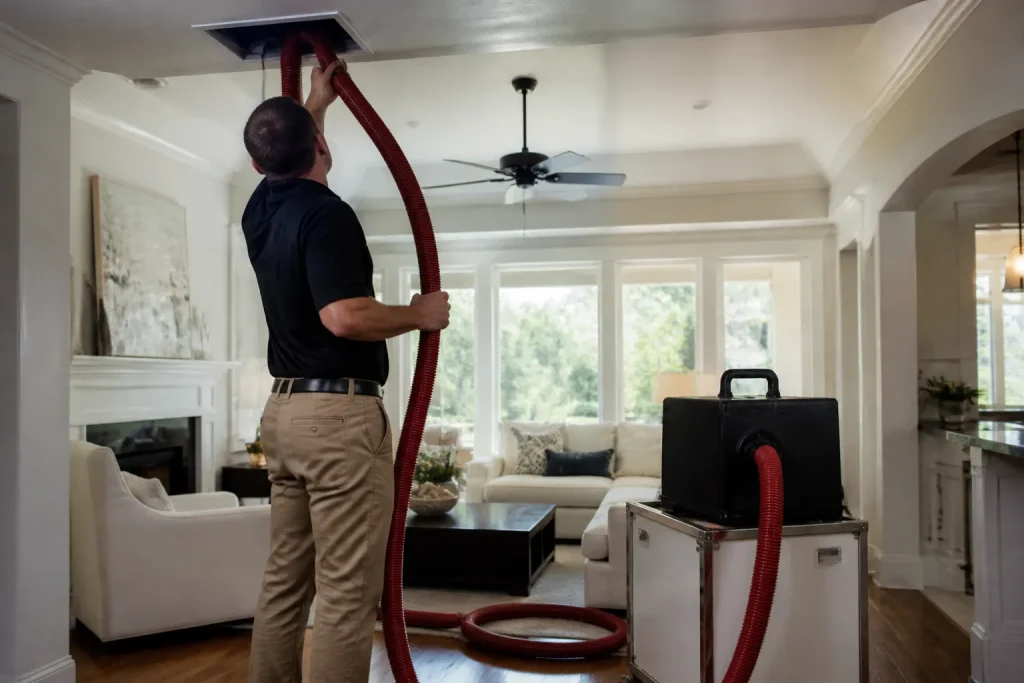
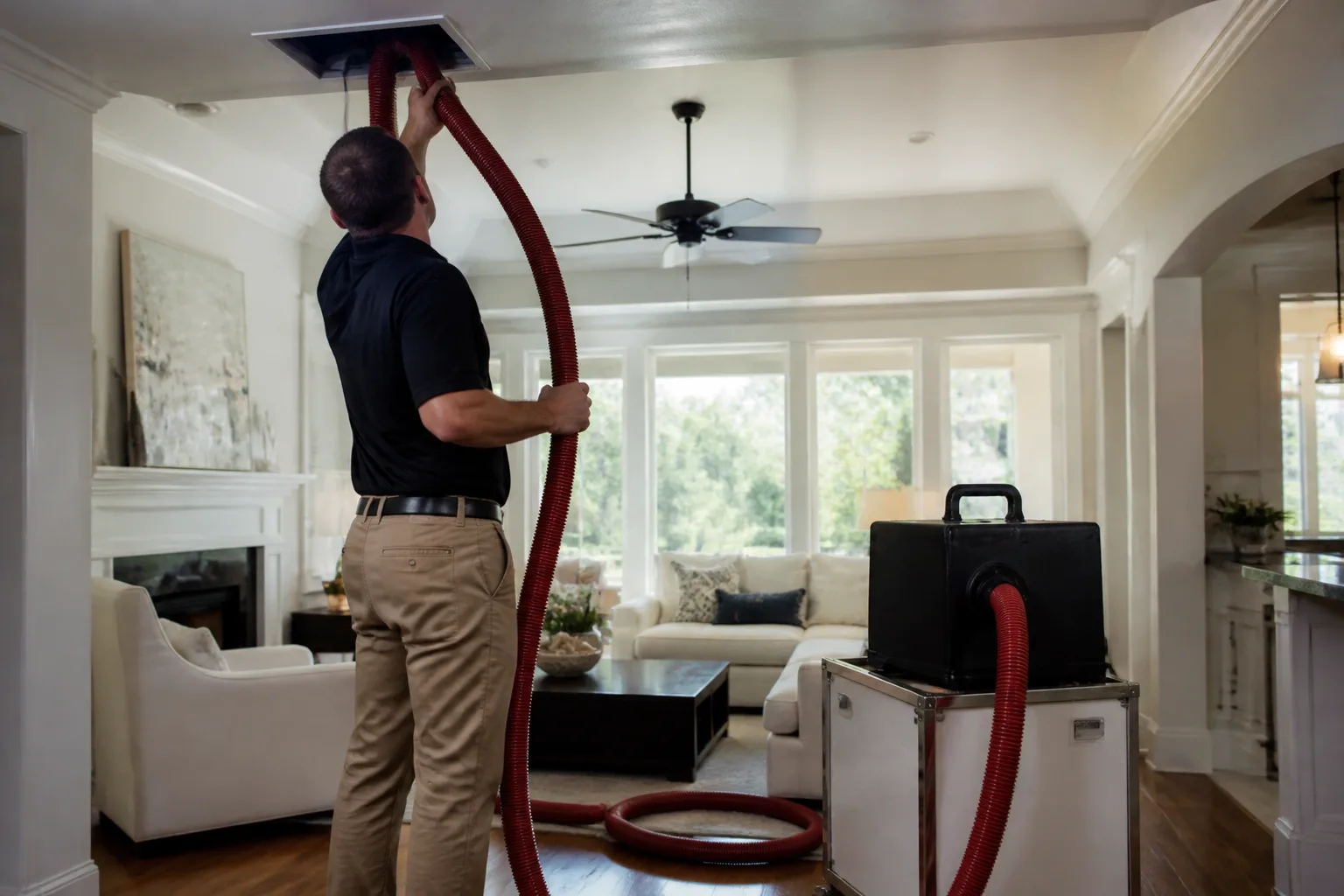
A Nikro duct cleaning unit is a HEPA-filtered negative-pressure machine. It’s connected to the duct system at a central point, usually near the air handler or through a purpose-cut access port, and it pulls air out of the ducts faster than any single register can supply it. The result is continuous suction across the whole run. Air moves toward the collection point, not out into the room.
The mechanics that matter:
- High CFM through a sealed HEPA filter. The vacuum pulls a strong, steady airflow through multi-stage filtration, capturing fine particulate before the air is exhausted back into the home. A sealed unit means the dust stays inside it.
- Containment design. Debris drops into a removable collection bag or bin rather than a fabric sock. You can see what came out, which is a fair way to judge the work.
- Pressure integrity across the run. The machine is sized to the duct system so suction stays strong from the register closest to the unit all the way to the farthest one in a big Kingwood two-story. That’s not a small point.
- Source-side agitation. While the vacuum holds negative pressure, a technician works each register with a rotary brush or air whip to break material loose into the moving airstream. The vacuum never stops, which is the whole idea.
Compare that to a portable shop-vac rig. A shop-vac pulls maybe a fraction of the CFM and has no real containment besides a filter bag. When the rotating brush knocks mold spores and dust off the duct wall, the shop-vac can’t keep up with the release. Some of it gets sucked in. Some of it slowly settles back into the duct, and some of it wafts out the register. A Nikro system is engineered specifically to prevent that second outcome.
Why long duct runs in Kingwood’s larger subdivisions need pressure, not just a brush
Homes in Kingwood’s bigger subdivisions – think the ones with long trunk lines feeding upstairs bedrooms and a rear living area – can have fifty, sixty, sometimes eighty feet of ductwork between the air handler and the farthest register. That distance is where pressure integrity earns its keep.
A rotating brush on a cable will physically scrub the duct wall. Good. But the debris it dislodges has to go somewhere. In a short duct run, a modest vacuum can keep up. In a long run, the same vacuum loses suction by the time it reaches the last register, and the loosened material simply deposits further downstream – or recirculates into the room. That’s how you end up with a clean-looking duct near the air handler and a dirty one behind your daughter’s bedroom door.
A properly sized Nikro unit maintains negative pressure across the full length of the run, so material dislodged at the farthest register is still being pulled back toward containment. In our experience with Kingwood homes, this is the single biggest visible difference between a real clean and a surface one. It’s also why the machine has to match the duct system – a unit that’s too small for the run is worse than useless, because it gives you a false sense of a clean.
Homes with a single central return and a long trunk line are especially vulnerable to re-deposition. If you can’t see the containment unit and the technician can’t tell you roughly what CFM the machine runs, that’s a red flag worth asking about before work begins.
What should a Nikro-equipped technician do at each register? A job-site checklist
You don’t need to supervise every step, but you can glance at the work in progress and know within a minute if it’s being done right. Here’s what should be happening at every register and return.
- Access points sealed before the vacuum starts. The main line is connected, sealed, and the negative-pressure unit is running before any register is opened. If you hear the vacuum cycle on and off, ask why.
- Each supply register individually worked. The technician removes the grille, runs a rotary brush or air whip down the branch, and holds the tool in place long enough for the moving air to carry debris back to the unit. Rushing this step is the most common shortcut.
- Returns treated the same way, not skipped. A return duct collects dust from your whole house. It needs agitation and extraction just like a supply branch, and a crew that skips returns isn’t finishing the job.
- Air handler and plenum checked. The blower compartment and the area around the evaporator coil should be inspected and, where accessible, cleaned. Duct cleaning that stops at the air handler door is partial duct cleaning.
- Registers reinstalled and system tested. Every grille goes back on, the system is powered up, and airflow is confirmed at each register before the crew leaves.
- Containment opened in front of you. The collection bag shows what came out. A crew that has nothing to show is a crew you should ask a question.
“Professional-grade equipment” is a phrase thrown around a lot. What it means on-site is that the machine, the agitation tool, and the containment design all work as one system. Rotobrush and Nikro are the two systems our technicians train on, and the difference between them and improvised rigs is measurable at the register.
Mold and allergen capture: why continuous pressure is the difference between extraction and redistribution
Pollen, pet dander, dust mite debris, mold spores. All of these are fine enough to travel with airflow and small enough to lodge in the lining of a duct. When a rotating brush contacts them, they go airborne in a burst. If the vacuum is holding continuous negative pressure at that moment, they get pulled into containment. If it isn’t, they get pushed out an adjacent register, into the room, into the return, and eventually into your lungs.
That’s the mechanical case for Nikro-style continuous-pressure cleaning. It’s also why our team keeps Abatement Technologies equipment on hand for serious contamination situations – the kind that call for a higher level of containment than a routine cleaning. Visible mold inside a duct, heavy allergen buildup after water intrusion, or post-renovation drywall dust in the system are the scenarios where that capability matters.
Kingwood’s climate adds a specific pressure to this. Humid air is not the enemy of ductwork by itself, but it’s what biofilm in the duct lining needs to grow. Condensation accumulates on cool duct surfaces in the summer, dust settles, and the two together make an environment where a thin film of biological growth can establish over time. Cleaning that film at the surface isn’t enough; it has to be fully removed and the system sanitized so residual material doesn’t re-seed. Continuous negative pressure during agitation is how that’s done properly. Guardsman sanitizing products are part of the same visit when the situation calls for it.
When to call a pro – and when cleaning isn’t the whole answer
Most ducts don’t need annual cleaning. The EPA’s general guidance is every three to five years for a typical home, more often with pets, recent renovations, allergy sufferers in the household, or visible mold growth. In Kingwood’s humid climate, we’ve seen homes fall on the more-frequent side of that range, particularly after a bathroom remodel or a water event.
Here’s the call we make on most visits: if the ducts are dirty, cleaning them helps. If the ducts are dirty and leaking at the joints, cleaning alone is a treadmill. A sealed duct system holds pressure, keeps conditioned air where it belongs, and stops pulling unfiltered attic or return air back into the supply side. That’s why we offer sealing alongside cleaning rather than instead of it. Fixing the system, not just cleaning the surface, is the goal.
You should call a pro when:
- You can see dust streaks at the register face or around the grille collar
- Any member of the household has allergies that get worse indoors or when the HVAC runs
- You’ve just moved in, renovated, or had any water intrusion into the system
- The system has visible mold in a duct or on the plenum
- Airflow feels weak or uneven between rooms
- You haven’t had the system cleaned in several years and can’t say when it last was
If you’d rather leave the equipment to a crew that has it, we can help. Related services in Kingwood include air duct cleaning for the full system, dryer vent cleaning as a genuinely important fire-safety service separate from the comfort side, and HVAC cleaning when the air handler itself is part of the problem. And if you’d rather not think about ductwork again for a while, that’s fine too – so long as you don’t confuse “haven’t thought about it” with “clean.”
The Bottom Line
Nikro is a brand name, but what it actually buys you is a methodology: continuous negative pressure, HEPA-filtered containment, source-side agitation, and a finished system. You don’t need to know the CFM rating of the machine in your driveway. You do need to know that a qualified crew shows up with proper equipment, works every register and return, checks the air handler, and is willing to show you what came out. If a quote looks cheap and the process doesn’t include containment and full-system pressure, the low price starts to make sense – and not in a good way.
Kingwood homes deserve a clean that holds up under the humid air and long duct runs that make this area’s houses what they are. If you’re in Kingwood and need help, our team is happy to talk through what your system actually needs. Kingwood Air Duct Cleaning Co offers free estimates – call (833) 991-7731. We answer 24/7. Fast dispatch from 7am to 7pm, Sunday through Friday. The price is set per job by the written estimate, with one flat price per system agreed before work starts, and before-and-after photos of your own ducts when the work is done. Our technicians have up to 11 years of experience.
Frequently Asked Questions
Typical estimates for a full-system air duct cleaning in the Kingwood area run in the low hundreds to just under a thousand dollars for a standard single-family home, with higher figures for larger two-story homes, heavy contamination, or add-on sealing. The written estimate is the number that matters – ask for one before work begins, and be wary of a phone-quoted price that changes on-site.
Ask for before-and-after photos of your own ducts, not stock photos. Ask to see the containment unit open at the end of the visit. Ask whether every supply register and every return was individually worked, and whether the air handler compartment was inspected. A crew confident in its process will answer those questions without hesitation.
Usually because the equipment cost is lower and the process is shorter. A shop-vac rig costs a fraction of a Nikro or Rotobrush system, and a crew using one can be in and out in under an hour. The work looks similar from the driveway. What’s missing is the continuous negative pressure, so some of what gets loosened simply settles back into the duct or drifts out into the room.
The general rule of thumb is every three to five years for a typical home, more often with pets, allergy sufferers, recent renovations, or visible mold. Kingwood’s humid summers tend to push households toward the more-frequent end, especially when the duct system also has leaks that pull in unfiltered attic air. If you’re unsure, a free estimate includes an inspection that answers the question honestly.
Call (833) 991-7731 to schedule an inspection and estimate. Estimates are free, and the price is set per job. If you’d rather explore the company first, take a look at Kingwood Air Duct Cleaning Co.
Written by the team at Kingwood Air Duct Cleaning Co.
Need Air Duct Cleaning Help?
Call Kingwood Air Duct Cleaning Co - the local pro we connect you with is licensed and insured, here with fast help in Kingwood.
(833) 991-7731